
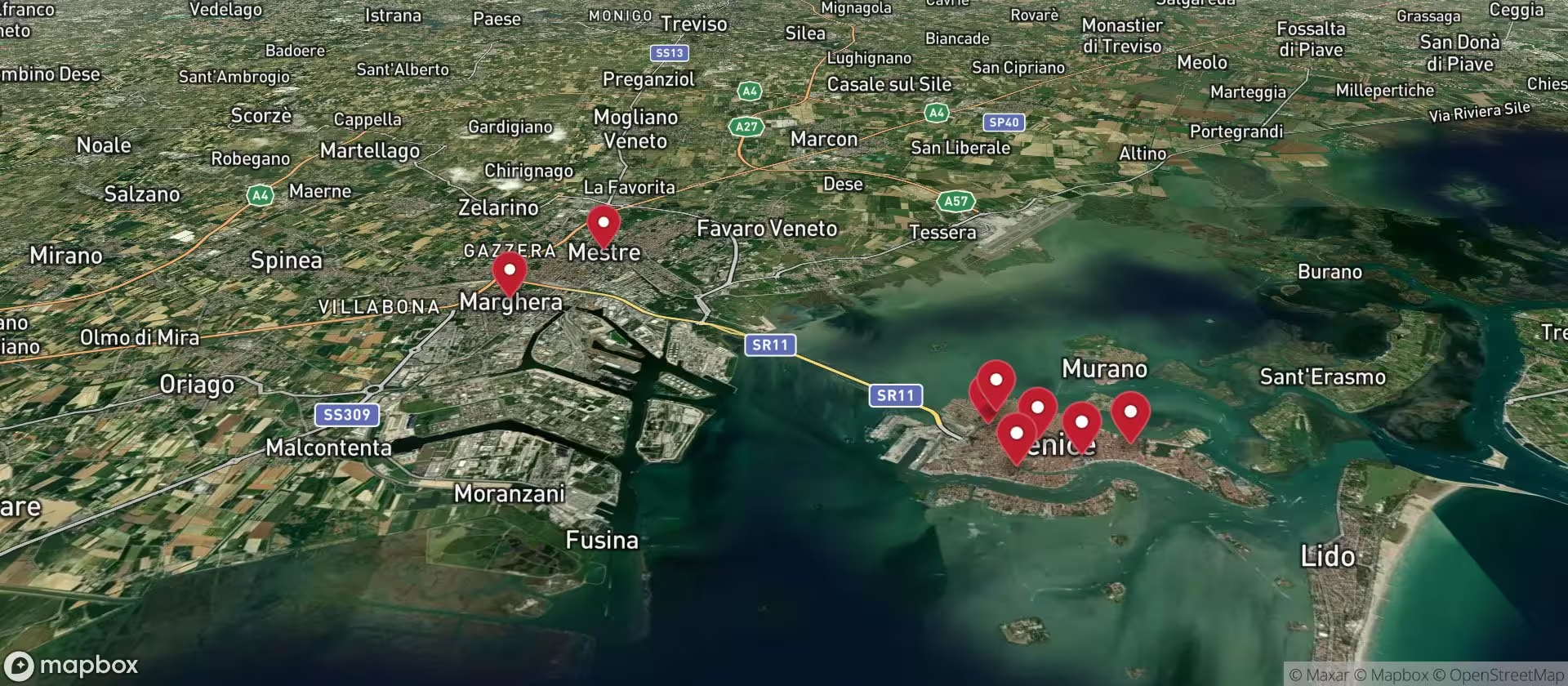
Most of modern-day Venice is located on the mainland, and the majority of its residents live there as well. Only two districts are situated on islands: the Centro storico (the historic center, including Burano, Murano, Torcello, and Giudecca) and the Lido di Venezia.
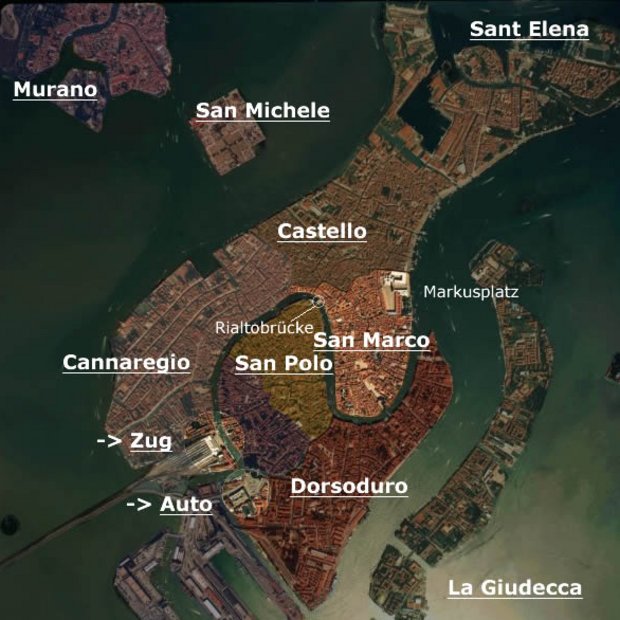
San Polo
A small, central neighborhood centered around the Rialto Bridge and the famous Rialto Market.
Santa Croce
A quiet neighborhood near Piazzale Roma with traditional alleyways and good access to the mainland.
Cannaregio
A lively neighborhood located in the north, home to many locals, the Jewish ghetto, and quiet canals away from the main thoroughfares.
Castello
San Marco
Historisches und touristisches Zentrum von Venedig rund um den Markusplatz, den Dogenpalast und die wichtigsten Sehenswürdigkeiten.
Dorsoduro
An artsy neighborhood home to universities, the Peggy Guggenheim Collection, and a laid-back atmosphere along the Zattere.
Marghera
An industrial district on the mainland with port facilities and residential areas.
Mestre
The mainland center of Venice, featuring modern infrastructure and serving as a major transportation hub for the lagoon.
The western part of Venice, where you arrive when coming to Venice by car, bus, or train. Parts south of the Grand Canal are also included.
The part of Venice that everyone knows, even if they've never been there. This is where you'll find the San Marco complex (the Basilica, the Doge's Palace, the Campanile, and St. Mark's Square), the Correr Museum, and the Teatro La Fenice. In case you haven't noticed: you'll get ripped off here; prices are higher than in other parts of the city.
This is the southwest part of Venice, including Giudecca, where the Peggy Guggenheim Collection is located. Dorsoduro isn't as crowded; here you can actually still find restaurants that are mostly frequented by locals (tip!).
The largest district in eastern Venice. It begins immediately behind the Doge's Palace (the exact boundary is the Bridge of Sighs) and includes the Arsenale and the Biennale grounds.