
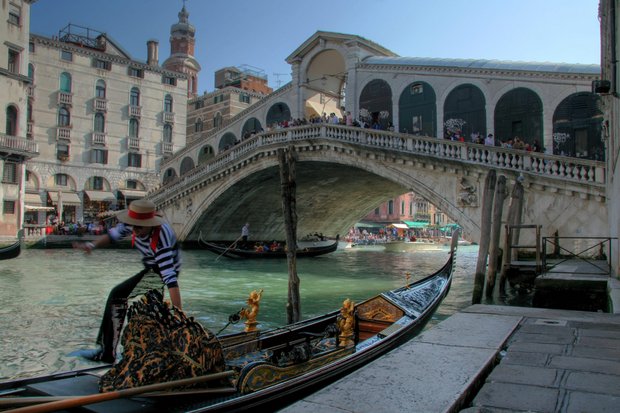
Probably the most overused motif in the history of photography.
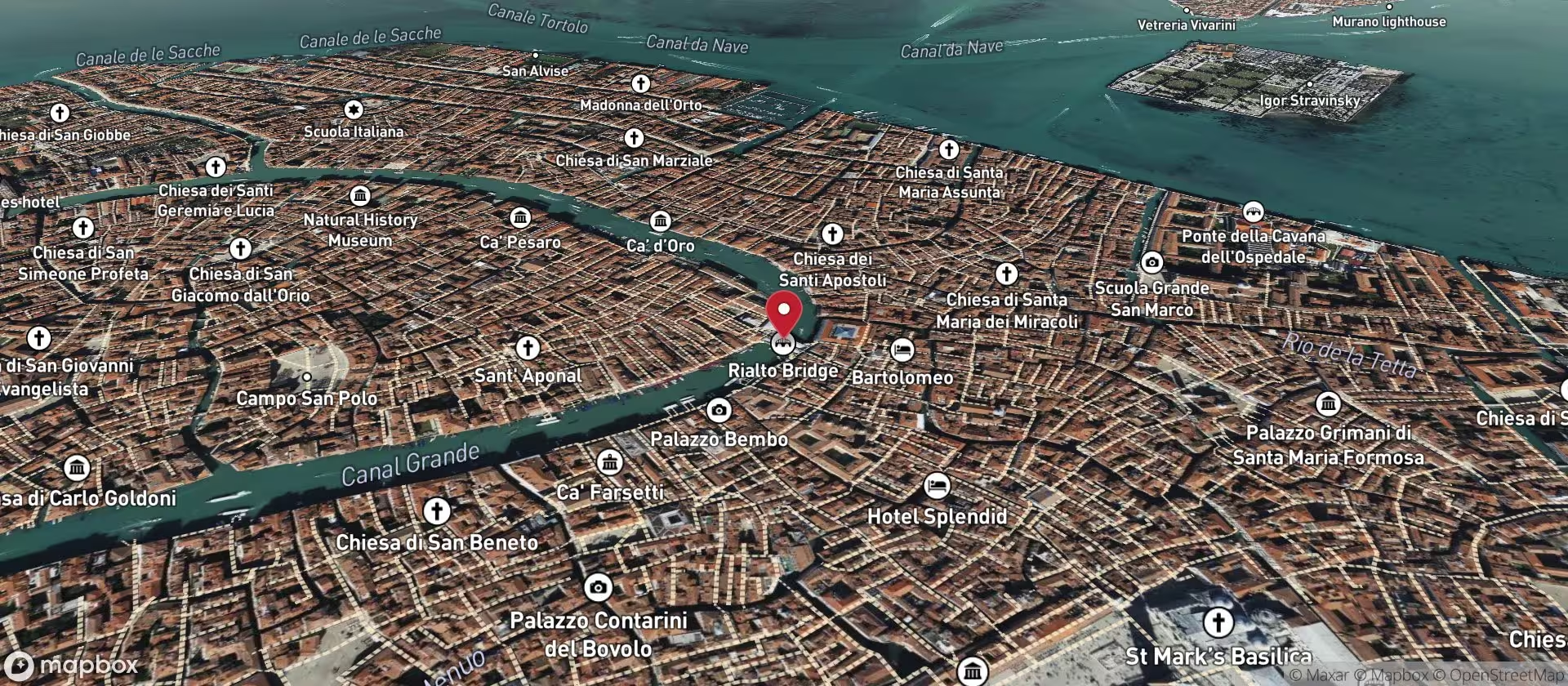
In the Sestiere San Polo, Venice's smallest and oldest district at 34 hectares, the Rialto Bridge spans a wide bend of the Grand Canal. The name derives from *Rivo alto* (or Latin *rivus altus*). This part of the city lies higher than the other sestieri and is therefore better protected against flooding.
The eastern part of the Rialto consists of a colorful mix of old houses and palaces, marketplaces, small squares, shops, and stores, while the part west of the Rio San Polo boasts impressive religious buildings such as the Church of San Rocco, the Scuola San Rocco, the Church of Santa Maria Gloriosa dei Frari, the Scuola dei Calegheri, and the Church of San Polo, to name just a few.
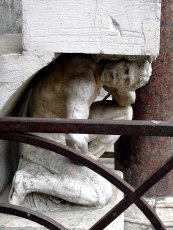
The Hunchback of Rialto
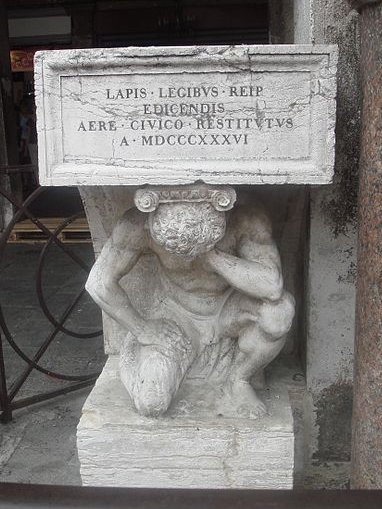
El Gobo di Rialto
A Timeless Record of the Tax Burden
The Gobo di Rialto (the Hunchback of Rialto) is a small statue of a kneeling man (dating from 1541) supporting a flight of steps. It is also a symbol of timeless relevance, as the Venetians saw in it a representation of the tax burden weighing upon them.
Next to it stands a column of pink granite - the Pietra del Bando - on which the decrees of the Republic were proclaimed.
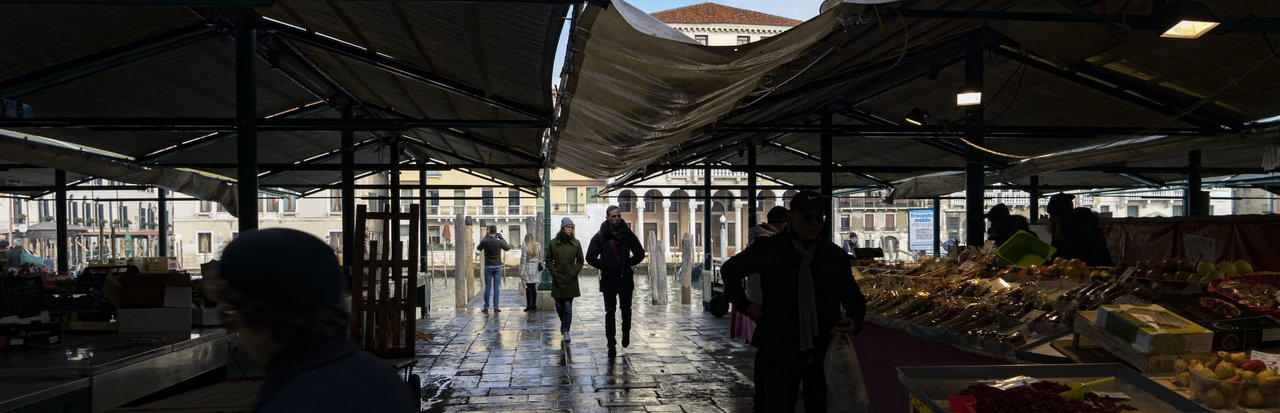
Venice Weekly Market
Rialto Weekly Market
Venice's main market is still held in Rialto today. Early in the morning, locals come to shop, soon giving way to tourists, and souvenir vendors take over the bustling scene. (Market open daily except Sundays; fish market in the Pescheria open only Tues. through Sat. from 5:00 a.m. to 11:00 a.m.).
Here you will find an overview of the weekly markets in Venice.
Venice is a challenge even on foot; in a wheelchair, it's a real ordeal. That's why knowing the maps of accessible routes in Venice is a real advantage.
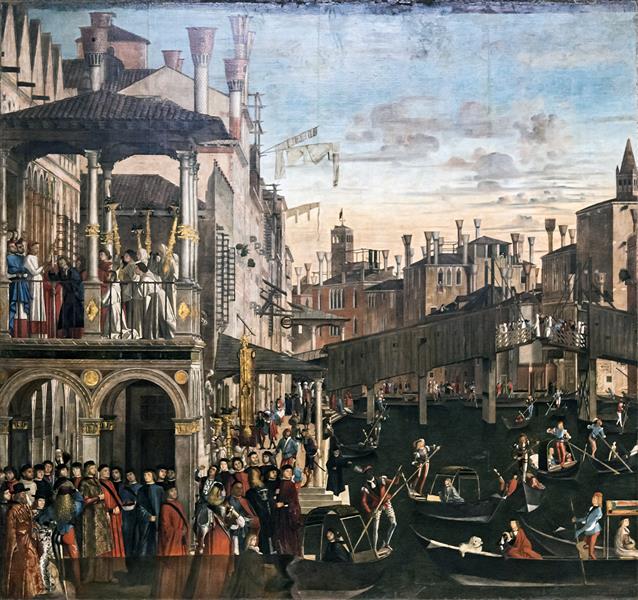
Caravaggio, the Miracle of the Cross Relic
Image creditA Pontoon Bridge
to become the Icon
After the Doge moved his residence from Malamocco to Rialto in 810, Venice's political and commercial power was concentrated in San Polo for the next thousand years. Incidentally, this is also where the building at number 1, the Corte dei Conti, is located.
In 1097, the main market was moved here, and boats formed a floating bridge across the canal. This bridge was replaced by a wooden bridge between 1200 and 1260. After it was rebuilt following an arson attack, it collapsed in 1444 under the weight of a large crowd of onlookers gathered for the wedding of the Duke of Ferrara.
The subsequent third bridge, a masterpiece of carpentry featuring two movable sections in the center to allow ships with tall masts to pass, was immortalized by Caravaggio in his painting The Miracle of the Holy Cross.
By 1524, the Rialto Bridge was in such poor condition that it was decided to build a stone bridge. Among those who submitted bids were Palladio, Sansovino, Scamozzi, and Michelangelo. The contract was ultimately awarded in 1588 to the architect Antonio da Ponte.
The construction of the bridge
required precise calculations given the instability of the ground and the required height of 7.5 meters and length of the arch spanning 48 meters, so that galleys could pass through.
Da Ponte designed a single-arch solution made of Istrian marble. It rests on 6,000 oak piles driven into the muddy ground.
Three pedestrian walkways span the massive arch, separated by two rows of shops. These tiny shops mainly sell jewelry, leather goods, souvenirs, and kitsch. From the upper bridge platform on the outer walkway, one has a fantastic view of the bustling activity on the Canal Grande and its banks.
Until the construction of the Accademia Bridge in 1854, the Rialto Bridge was the only crossing over the Grand Canal for hundreds of years.
Between the 13th and 15th centuries, the Rialto was the hub of economic activity: long-distance traders unloaded their goods at the quays, the largest banking and trading houses had their headquarters there, shipping insurance companies, workshops, and shops selling luxury goods all established themselves in the area.
The adjacent Fondaco dei Tedeschi
served as Venice's main post office for a long time until it was acquired by the Benetton Group in 2011, which converted it into a luxury department store. While this may be regrettable, it has made the Fondaco's roof accessible to the public, allowing visitors to view the Rialto Bridge from a previously unseen perspective.
It was in the interest of the Serenissima to become a hub between the East and the West. The city pursued a policy of welcoming foreigners with tolerant legislation. Any merchant could live here as long as he paid his taxes on time. Over the years, various offices were established here, such as the tax administration and the magistracies entrusted with overseeing the guilds.