
The origins of this tradition date back to 1162, when Venice defeated the powerful Patriarch of Aquileia. During the battle, Patriarch Ulrich and 12 of his canons were taken prisoner. As a symbol of submission, the Venetians - not without a touch of sarcasm - demanded an annual tribute of twelve pigs and a bull in exchange for the prisoners.
Since then, the animals have been ceremoniously put to death in an annual mocking festival:
in front of the Doge and the people, the pigs were thrown from St. Mark's Tower, and the bull's head was cut off. This was the highlight of Carnival.
In the 16th century, this festival was delightfully refined: instead of pigs, an acrobat swung from a raft in the Bacino di San Marco on a rope to the top of the Campanile and let himself down from there across the Piazzetta to the Doge's Loggia in the Palazzo - "as fast as an arrow," as the chroniclers say - and presented the Doge with a bouquet of flowers.
After the first of these acrobats, a Turk, this part of the festival has since been called the Volo del Turco, the Flight of the Turk, even though by the 16th century it had become a fixed privilege of the arsenalotti, the shipyard workers of Venice.
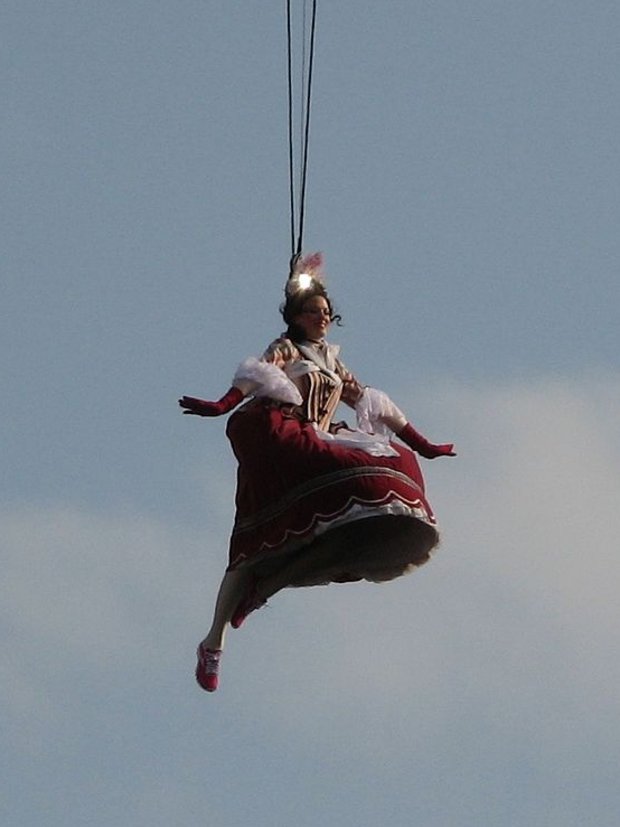
Giovedi Grasso ended with a magnificent fireworks display on wooden towers, relics of the conquered castles of Friuli. Over time, this tradition became increasingly diluted, and so the rope was eventually stretched only between the Campanile and the Doge's Loggia. In the end, people settled for simply lowering a harmless angel from the Campanile.