
But this location, too, proved to be less than ideal due to the climatic conditions, as the salt pans had by then turned into marshland, causing the deaths of a large portion of the population.
By around 1630, the population was growing increasingly dissatisfied with this predicament, and so Cervia was relocated once again on November 9, 1697, at the behest of Pope Innocent XII. This time, however, it was for good. And, provided Cervia is not relocated yet again, it stands there to this day.
Sapore di Sale
Salt Festival in Cervia
Thanks to its purity, Cervia salt is considered one of the best in Italy. Because of its high sodium chloride content (>97%), it doesn't have a bitter taste. Every year, Cervia hosts a salt festival (Sapore di Sale), usually on the first weekend in September. /more
There is little historical evidence regarding Cervia, which is likely why the town's history is shrouded in mystery. However, it is believed to be of Greek origin.
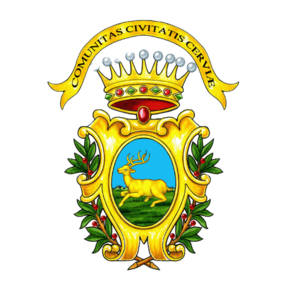
According to legend, Cervia was founded by Emperor Barbarossa. Originally, the town was not called Cervia, but Ficocle. Some claim this is because there were so many deer (Latin plur. cervi) in the surrounding forests.
The locals seem to agree, as can be easily seen from the town's coat of arms. More likely, however, is that the name derives from the huge piles of salt (acervi) that were produced here in large quantities in salt pans. A pile of salt on the coat of arms, of course, would not have been very representative.