
City Hall
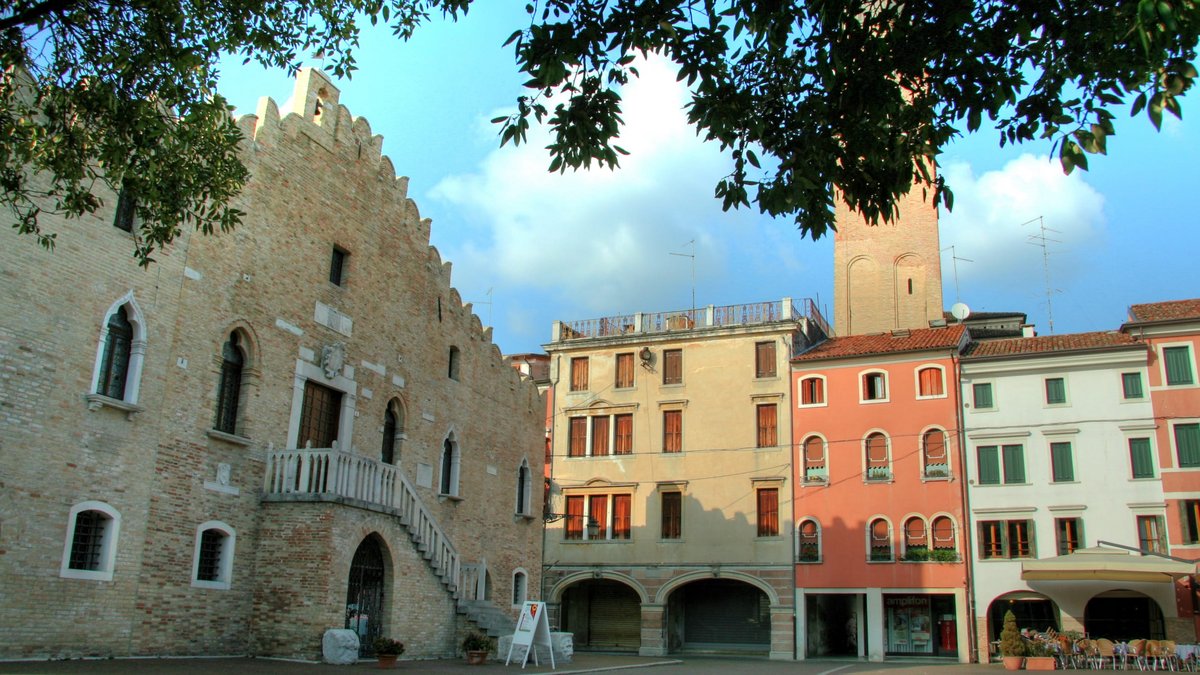
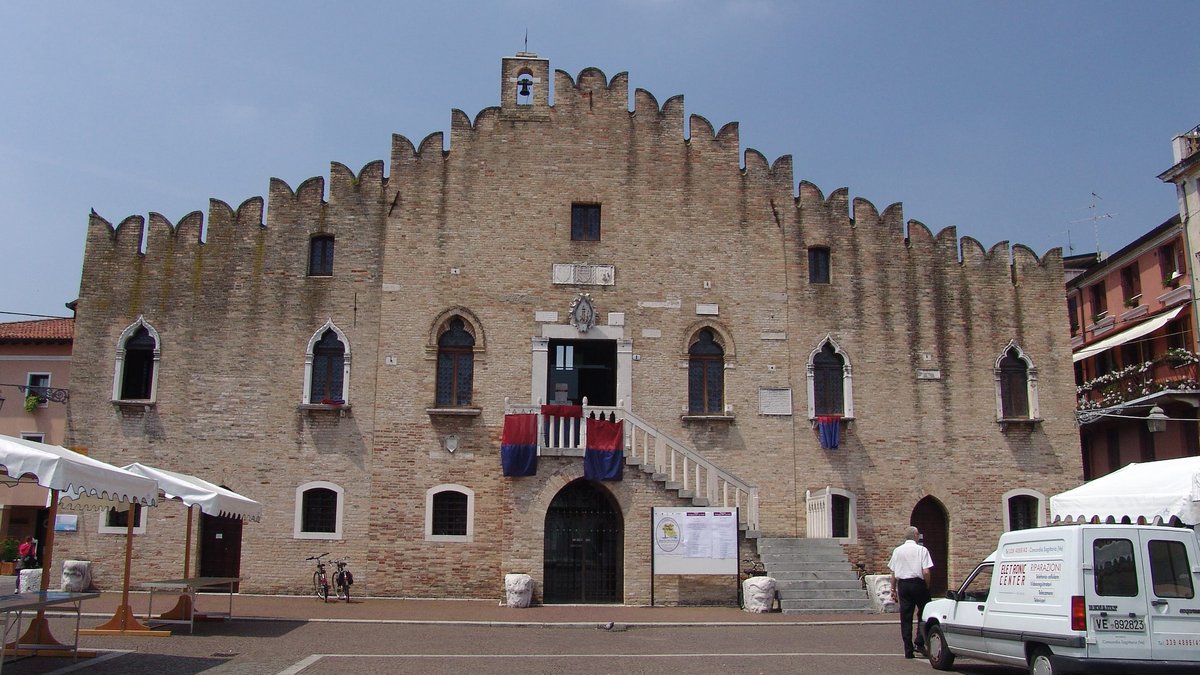
The Portogruaro Town Hall, which has served as the town hall for over 800 years, is undoubtedly the town's most impressive landmark and a particularly fine example of local civic architecture. The Gothic building, whose main façade is made of brick, was constructed over the course of two centuries.
The older part is undoubtedly the central section, whose window arches on the Belle Etage are elaborately crafted from brick, while the window frames in the two side sections are made of white natural stone. Documents from the 13th century already mention the Loggia del Comune, the town hall. Thus, the construction date of 1265 - to which the central section was dated by the city historian Antonio Zambaldi - seems plausible.
As a result of the Barden uprising in 1371, the palace caught fire. To suppress the unrest and restore its prestige, Marquado, the Patriarch of Aquileia, intervened in the disputes, and it was precisely at this time - according to historian Degani - that the municipality likely had the new loggia built with its unique Ghibelline battlements.
After all that culture and history, here's the good news: right next door is Bar Roma, where you can enjoy the truly enchanting view in peace while sipping a cool glass of Prosecco.
Al Cavallino
Restaurant Recommendation
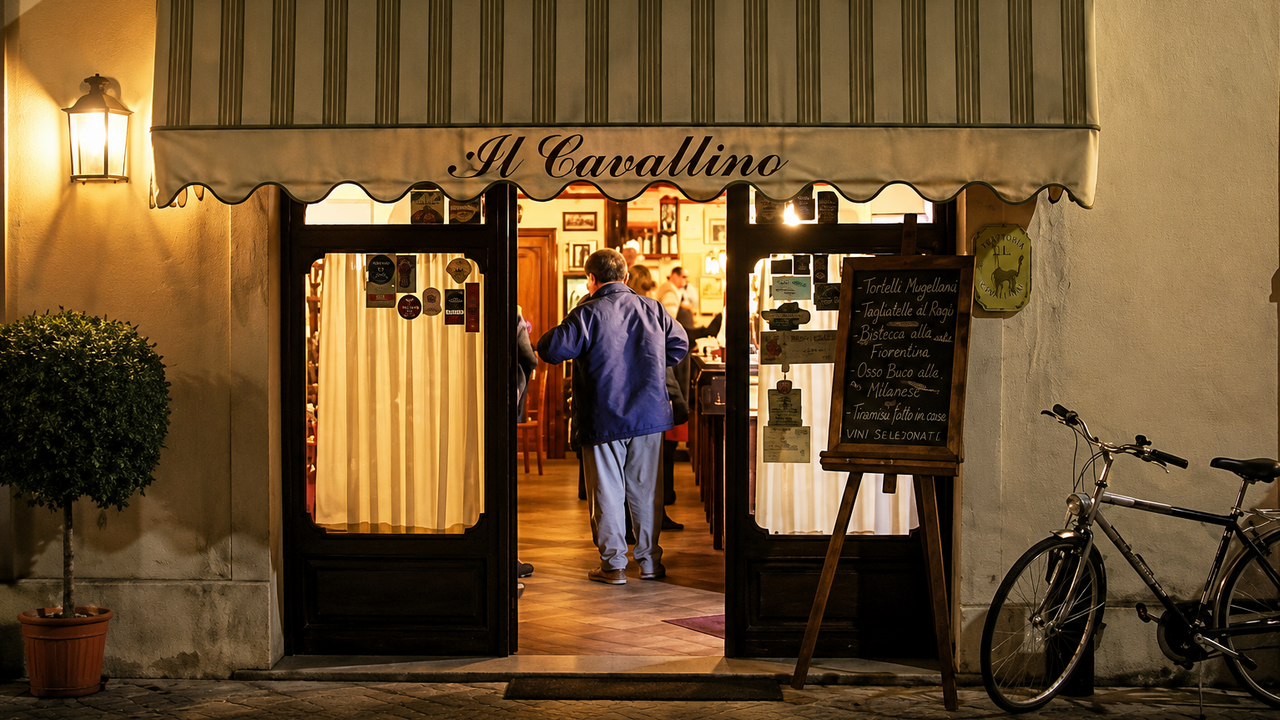
After a leisurely stroll through the charming old town, there's no better place to relax than at Trattoria al Cavallino (easy to find near Porta San Agnese - any local can point you in the right direction). Here, in a rustic, cozy Italian setting, you can look forward to the best that local cuisine has to offer. (We highly recommend the Tagliata con Ruccola e Grana - a perfectly seared beef tenderloin with arugula and Parmesan shavings. In fact, there are guests who, honestly, have ordered nothing but this famous Tagliata for the past six years!)
Of course, this doesn't mean that other dishes aren't worth trying. The homemade Petto d'anitra (duck breast) is particularly delicious, especially with a balsamic sauce; or the Cape lunghe, well-known in the area (available during the colder seasons)... In any case, you won't be disappointed - just like the locals who love to dine here. And don't forget to say hello to Franco, the owner, from meineAdria.com. Then he'll turn a blind eye to the bill ;) … and be sure to try one of the delicious desserts, originally homemade by Mama!!!
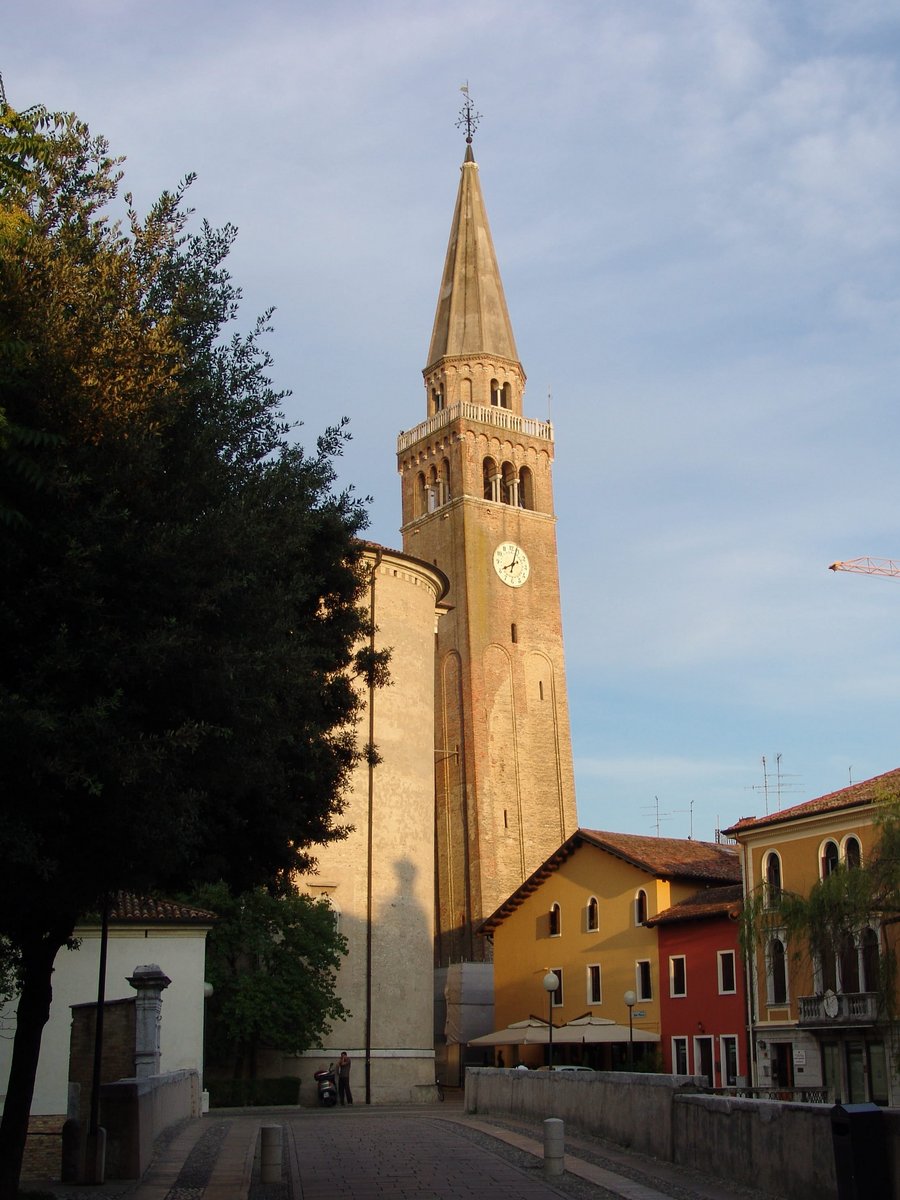
Rear view of Portogruaro Cathedral with its leaning bell tower
Cathedral
This cathedral was built in the early decades of the 19th century on the site of a Romanesque church.
All that remains of this earlier building is the slender, leaning tower, whose upper story is pierced on all four sides by triplet windows. The octagonal belfry above it, however, is divided by twin windows and crowned by a pointed spire.
In a niche on the outer wall of the cathedral's apse stands a Madonna and Child, a beautiful 14th-century marble sculpture. The simple, three-nave interior of St. Andrew's Church opens into a long chancel. Notable works of art include "The Last Supper" above the main entrance, attributed to Pietro Muttoni; "St. Roch" by Antonio Carneo on the second altar on the right; and "The Resurrection" from the school of Palma il Giovane on the fourth altar on the right.
The central oil painting in the apse depicts "The Presentation of Jesus in the Temple" by Giovanni di Martino. The painting on the left in the presbytery depicts "The Holy Conversation" by Pomponio Amalteo, who also painted the panels on the right and the last two on the left of the choir stalls, while the first panel on the left, "The Last Supper," is attributed to Gregorio Lazzarini.
Also worth mentioning is the oil painting *Madonna delle Grazie* by Pietro Damini on the third altar in the left aisle.
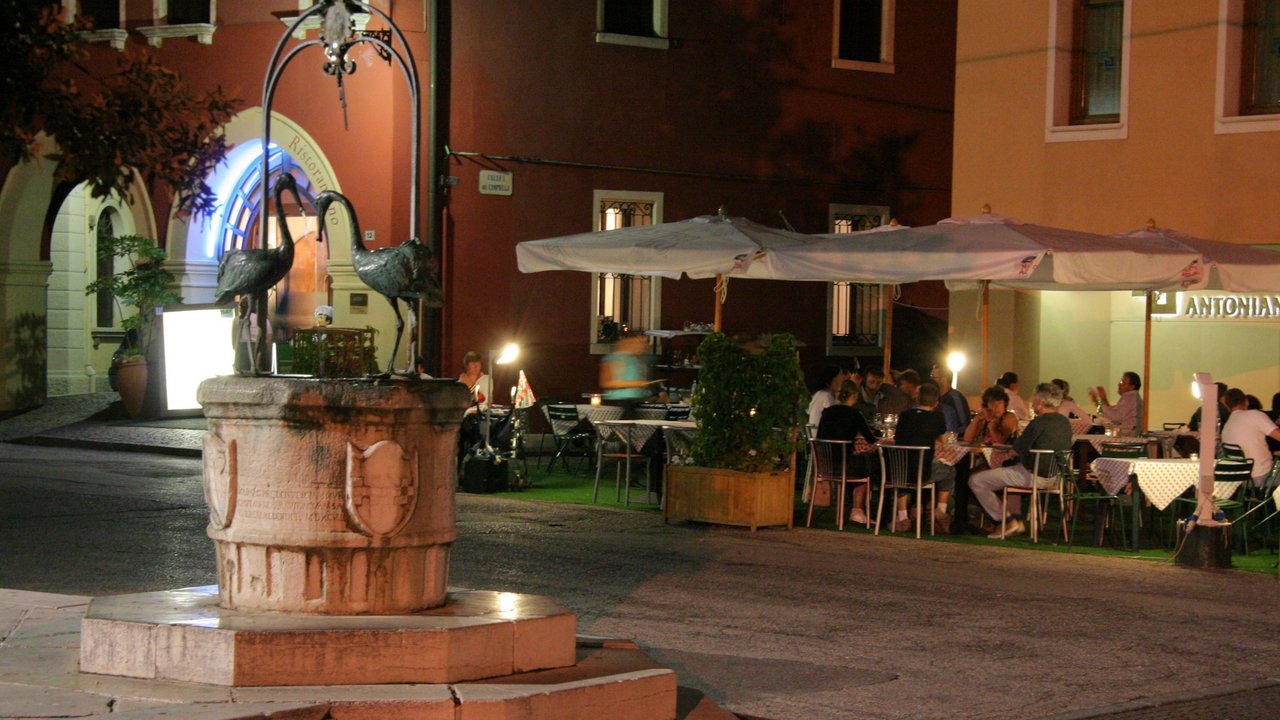
Pilacorte Fountain
To the left of Portogruaro Town Hall, standing on an octagonal base, is one of Portogruaro's landmarks: the Crane Fountain. It was designed by Giovanni Antonio Pilacorte in 1494. Carved into the outer walls of the octagonal fountain basin, alongside the city coat of arms, are the coats of arms of Paolo Contarini and Jacopo Gabriel, who were likely mayors at the end of the 15th century. The two cranes are the work of Valentino Turchetto. (Crane is "gru" in Italian, hence the name Portogruaro, "Crane Harbor"). Originally, the Crane Fountain stood not far from its current location. It is fed by an underground cistern. An inscription from 1598, located to the right of the city coat of arms, states that this cistern was renovated by Mayor Giovanni Balbi to ensure a supply of clean water. In the 18th century, the fountain mysteriously and inexplicably fell into private hands. It was not until 1908, on the occasion of the inauguration of the public aqueduct, that it was ceremoniously returned to the municipality.
Villa Bergamasco
The date of the villa's construction is unknown. However, since it is attributed to Guglielmo de Grigis da Alzano, il Bergamasco (1480?–1550), it was likely built in the mid-16th century. Guglielmo was active not only in Venice, where he had moved - Bergamo was part of the Venetian sphere of influence - but also in Padova, Treviso, and Portogruaro.
This beautiful Renaissance palace was commissioned by Antonio Frattina. The villa's façade measures 35.50 meters, its depth is 25 meters, and its height is 14.50 meters. Like so many other houses in Portogruaro, it was certainly once decorated with frescoes depicting mythological figures - such as satyrs, horses, and monsters - which, unfortunately, have all disappeared since 1893.
Three busts have been on display in the villa's entrance hall for some time. The bust of Vittorio Emanuele II, commissioned by the municipal council from the Florentine sculptor Fantacchini in 1878; the bust of Giuseppe Mazzini, created by Valentino Turchetto in 1947; and the bust of the poet Fausto Bonò (1832–1890), a work by Leonardo Liso, a native of Udine, dating from 1892. In the colonnade of the guesthouse, you can see two marble medallions of Giuseppe Garibaldi and Camillo Cavour from around 1882.
The villa's beautiful and spacious park is also well worth a stroll and is always open during the day.
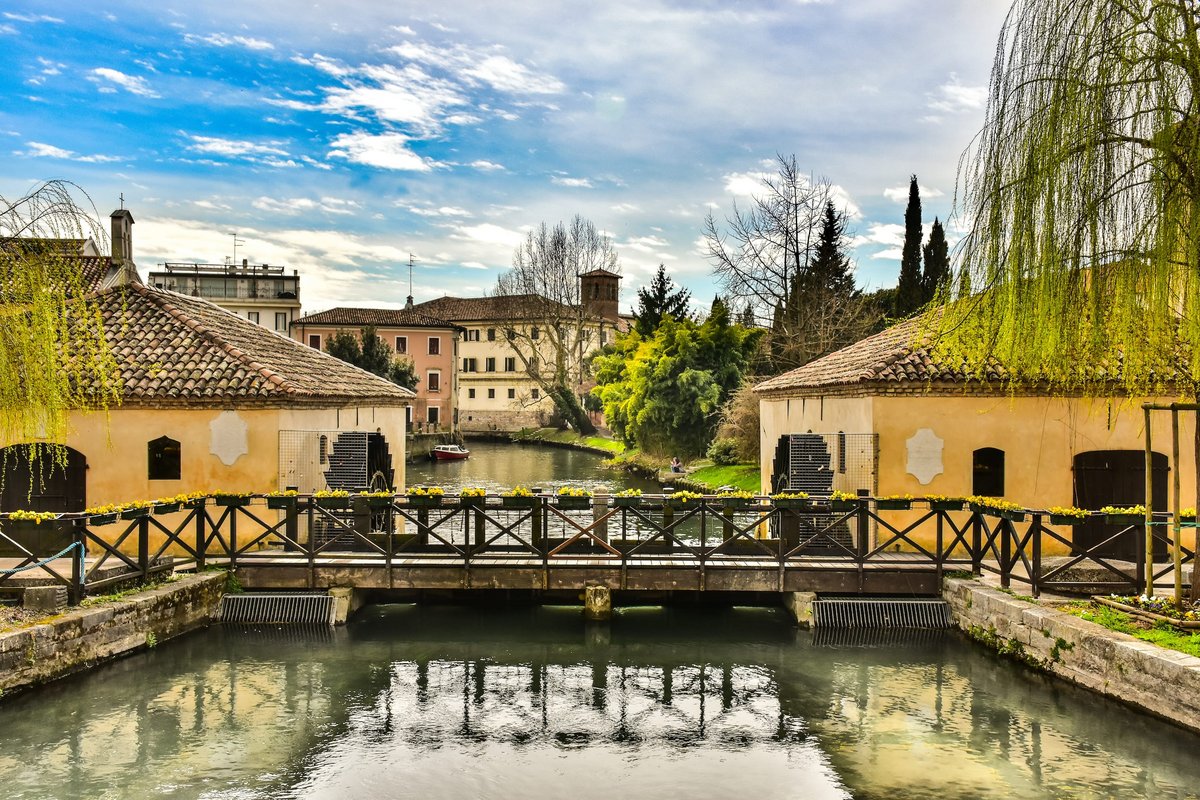
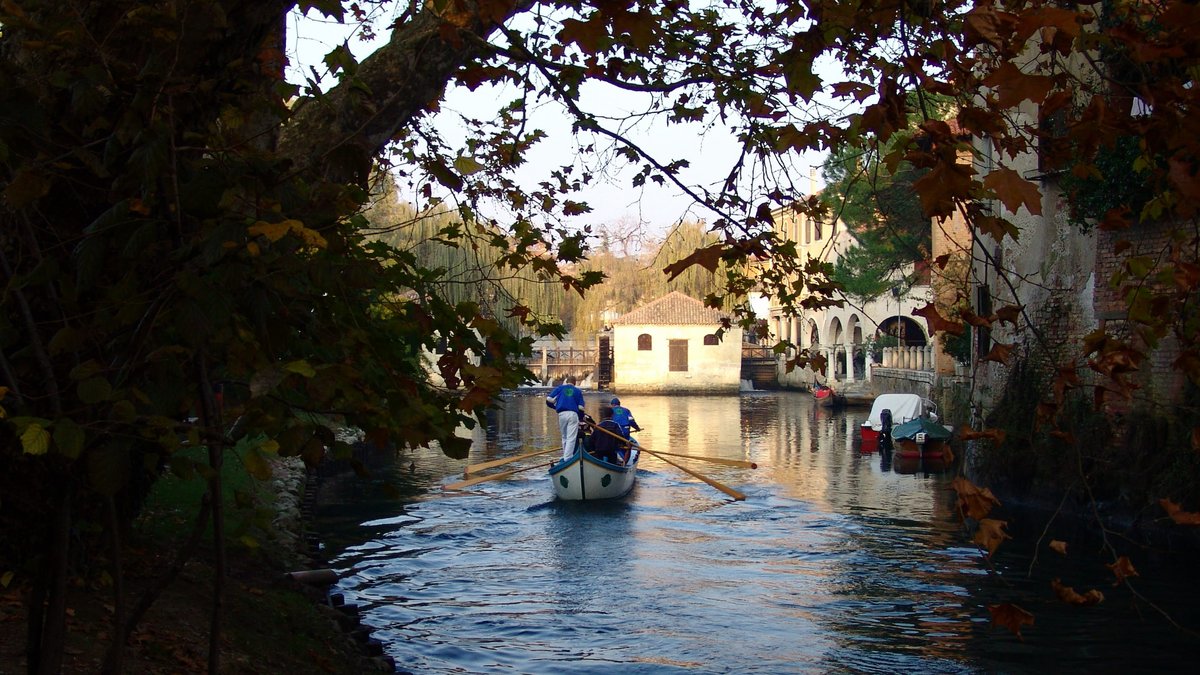
The Old Mills
The mills in the middle of the Lemene date back to the 12th century. They were built by the bishops of Concordia, who owned them until 1867. Management of the episcopal mills was typically entrusted to tenants, among whom women were not at all uncommon. In the 15th century, the mills operated 10 millstones, an indication of a remarkable volume of business. Perhaps there was a need to meet the population's high demand for flour products, as they were unable to sufficiently meet their own needs. Or perhaps they sought to free themselves from a kind of monopoly.
Whatever the case may have been, the maintenance of the mills of S. Andrea - as they were named after the nearby church - was the responsibility of the bishops of Concordia. Two of them, likely to document the full extent of the work they had undertaken, sought to leave their mark on stone; however, these inscriptions no longer exist today. Records exist of the mills' restoration work in 1477 under Bishop Antonio Feletto and in 1755 under Bishop Jacopo Maria Erizzo. After Venice's annexation to the Italian Empire in 1866, many church properties were confiscated by law and became state property, including the mills of S. Andrea in 1867. They were subsequently auctioned off in 1870 for 50,000 lire. In 1914, they were acquired by Giancarlo Stucky, the owner of the mills of the same name in Venice. After further changes of ownership, they finally came into the possession of the Lugugnana Cooperative in 1928. After more than 700 years, the mills were shut down.
In 1970, the municipality of Portogruaro acquired them. But these old structures, silent witnesses to so many historical events, were naturally in a state of serious disrepair. In the early 1980s, the decisive intervention of the Minister of Cultural Heritage and the Environment saved the mills from imminent ruin. The most recent restoration work was carried out partly by the Ministry and partly by the municipal administration and was completed in 1993. Thus, the "Ai Molini" City Gallery of Contemporary Art was able to reopen in the very mills where it had already operated successfully in the postwar years.