
Moving to Italy
- Where else would you go?
This article was originally published on meinGardasee.com many years ago. We are reprinting it here with the author's kind permission.
It could be so wonderful.
When you're sitting comfortably on the beach with a glass of wine, watching the sunset, quite a few people ask themselves: Why am I still living somewhere else? And that's how the idea of moving to Italy is born.
So close, yet so far.
If you visit Italy often, a certain familiarity quickly sets in - apart from your affection for this beautiful country - but this should by no means be confused with a true understanding of the country. It's no coincidence that the saying goes, "Different countries, different customs." This naturally applies to Italy as well, in countless details (as, for example, the german magazine Der Spiegel also reports).
Codice fiscale.
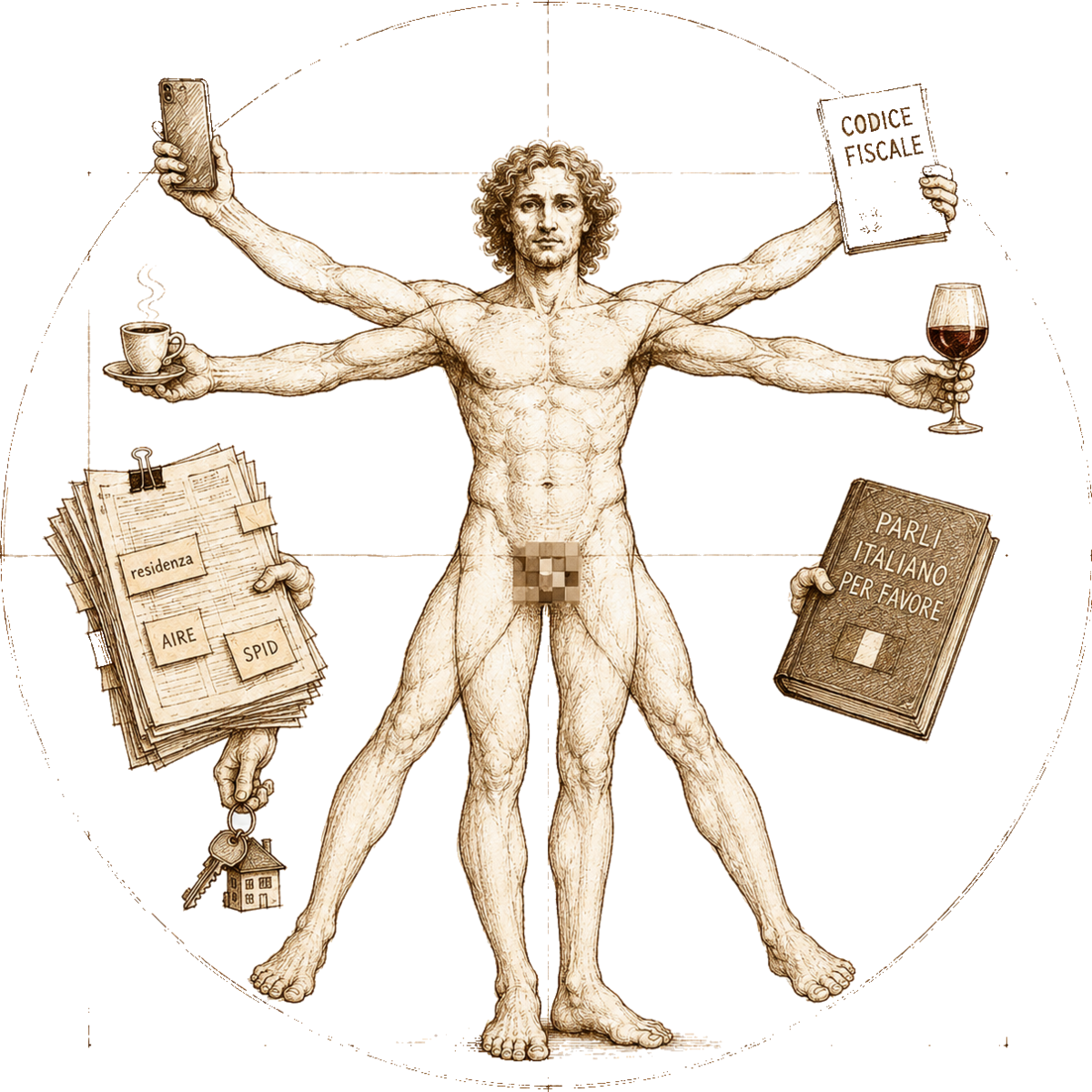
The very first thing you need if you want to do even the slightest thing in Italy is the so-called Codice fiscale. This is the tax ID number that every Italian receives virtually before they are even born. There are very few things in Italy that you can obtain as quickly and easily as the Codice fiscale. You can get it at the Ufficio delle Imposte, and you need it for just about everything (getting a phone, renting an apartment, or buying a house, etc.). Logically, you don't have to live in Italy to get the Codice fiscale. Anyone who wants it or needs it can get it.
Residence permit?
It is quite possible that you will need a residence permit (the Carta Verde). Technically, you shouldn't need one anymore since 1968, as Italy has ratified the relevant agreements, but apparently word hasn't gotten around everywhere yet. And so you might end up spending a day at the registration office, standing in a long, long line...
In any case, you should bring passport photos and the usual documents with you.
Language is key.
The best investment you can make in emigrating is to learn Italian beforehand. Emigrating to Italy is complicated enough, but without language skills, one is in for a steep learning curve the hard way.
Here's a good tip if you want to learn Italian:
Don't put your Italian lessons under your pillow - instead, keep them in the bathroom (and toss out the magazine). Since the bathroom is the quiet place you visit most regularly, you'll study there regularly too. After all: Repetitio est mater studiorum.
This is a tip, not a joke - it has been proven to work out just great.
The land of the informal channel.
Normally, when something needs to be done, like a burst pipe or repairs, one is inclined to consult the Yellow Pages. Not in Italy. Here you go to your local bar and ask the bartender. In general, it's a good idea to find a local bar as soon as possible and make it a regular spot, because when it comes to communication, Italy operates differently in this regard.
So you go to the bar and ask the bartender if he knows anyone who can do this or that, and he'll be happy to recommend someone to you.
This facet touches on a fundamental mental difference between teutonic and italian mentality. Italians are generally open-minded, friendly, and you can make contact very quickly. However, this should not be confused with "true" friendship; rather, it is a very good acquaintance. The reason for this is that in Italy, pretty much everything runs through personal connections and not through the Yellow Pages. A friend of a friend has a friend who, in turn, knows a friend who has exactly what you need. And because you never know when the Universe decided to bring people together by disaster like bursting pipes, Italians are friendly right off the bat. After all, it could be a case of give and take - you might need something from them someday, or they might need something from you.
So as soon as you have an apartment in Italy, the first thing you should do is head to the nearest bar and make your entrance.
Whatever you have in writing, you can safely take home with you.
When you go to the bank in Italy, you don't just walk right in. Instead, you usually pass through a single-person security gate where you're screened. If you have multiple cell phones with you, it's advisable to deposit them in the lockers before the gate. Then you go through again and have almost made it to the teller window.
You want a bank statement. Next surprise:
There are no self-service statement printers. So you'll need to get in line at the teller window. (If it's payday, expect the line to be very long.) When you ask the teller for a bank statement, they'll go to their computer, load a sheet of paper into the printer, and gladly print out your Estratto conto for you.
A visit from the authorities.
Once you've found an apartment, be prepared to get a visit from the police, even if you haven't done anything wrong. (This definitely applies to the Veneto region.) But in other regions will probably handle the situation similarly.
A Maresciallo (marshal) from the Comune will come by to verify whether there are really as many people living in the house or apartment as you've stated. All of this is for the purpose of calculating garbage fees, which are charged per person.
Garbage fees are no joke. You can tell this, among other things, by the fact that many Italians are actually very eager to throw garbage bags into every possible trash can - just not their own.
How to make money?
Of course, as a German speaker, you have decent chances of finding work in industries such as the hospitality sector. But it's important to remember that salaries in Italy are significantly lower than those north of the Alps.
Especially when it comes to taxation, Italy is very different from Germany. In principle, every Italian views the state as an enemy because they constantly feel cheated by it (who couldn't empathize with that?).
Now, the Italian government assumes that everyone earns a good portion of their income under the table (fuori busta) anyway. And accordingly, it has no problem charging 50+% in taxes. If you come along as a law-abiding German and truthfully report everything, you might be in for a surprise when you receive your tax bill. Of course, we don't want to encourage anyone here to engage in any shenanigans outside the bounds of tax legality, but in any case, consulting a commercialista or tax advisor is highly recommended.
Eh, Dottore?
If a dental filling fell out while enjoying that last Torta di Mandorla, you'll have no choice but to see a dentist. So make sure to carry cash, because there are things the Italian healthcare system simply doesn't cover. (Estimated cost: ~50 euros for a ceramic filling, depending on the dentist). But prices are way higher today.
Over time, you'll probably notice people in Italy with large gaps in their teeth. Among other things, this is a sign of what the healthcare system doesn't cover. That's why many Italians, especially in the north, prefer to travel to Croatia or Istria to see a dentist. And of course, you can't just pick any dentist (if you want insurance to cover it); instead, one is assigned to you based on which neighborhood you live in.
In any case, if you're still planning to move abroad, you'd be wise to look for a place that isn't too far from your home country, so you can get treatment there quickly in an emergency. You never know, non si sa mai.
Trick, disguise, deceive.
If you want to start your own business in Italy, brace yourself. Expect long payment terms - and not just from companies and private individuals. Even government agencies aren't particularly eager to pay bills. Payment terms like "end of the month + 90 days" are common even among official institutions. That said, it's entirely possible that someone will contact you one day before the 90-day period expires to formally dispute the invoice, requiring you to reissue it. So back to "end of the month + 90 days."
Or this, a popular one:
The customer doesn't pay, so you suspend your services. The customer swears on his grandmother's honor that he'll pay and sends you a fax of the bank transfer as proof (hard to read because it's on colored paper). So you set about making the hard-to-read text more legible using a graphics program. And then you notice this little box: Payment scheduled in two months.
Whatever you do or don't do in Italy:
Do not hope for the Italians to become creative, but count on it. Please don't confuse this with malice. Rather, it's often simply a kind of self-defense reflex that you're better off adopting in Italy in the long run.
As they always say so beautifully in so many movies, and not without reason: Hey, nothing personal...
And it really isn't. Please don't take what's described here as a moral judgment! Just get used to the idea that in Italy, a word or a promise simply doesn't carry the same weight as, say, in Germany or Austria. A given word tends to count for very little. And this is also something - keyword: "reliability" - that Italians particularly appreciate about Germans and Austrians, precisely because they lack it themselves. As said, nothing personally, because this circumstance is simply culturally determined. And you'll encounter it as soon as you cross the mental-cultural border at the Brenner Pass.
Misjudging this fact or being unaware of it is one of the main reasons why immigrants from the northern side of the Alps fail in business in Italy.
Like no other.
Despite all the pitfalls, rough edges, and challenges described, Italy is still a country where life is a joy. Especially the contact with the exceptionally kind people and the cultur is something you simply won't find anywhere else in this form.
Nowhere else will this happen to you: the owner of your favorite bar might be on vacation, but he'll still visit you at home with some homemade salami and a case of wine. Because he figures you might be sad that your favorite bar is closed and that you miss it. And of course, the owner wouldn't want that at all. That's why he brings you salami and wine.
Things like this really don't happen anywhere else, except in Italy.